New IRU Secretary General announced following member vote

New IRU Secretary General announced following member vote

New IRU Secretary General announced following member vote

IRU’s General Assembly of members has voted to officially appoint Habib Turki as its next Secretary General.

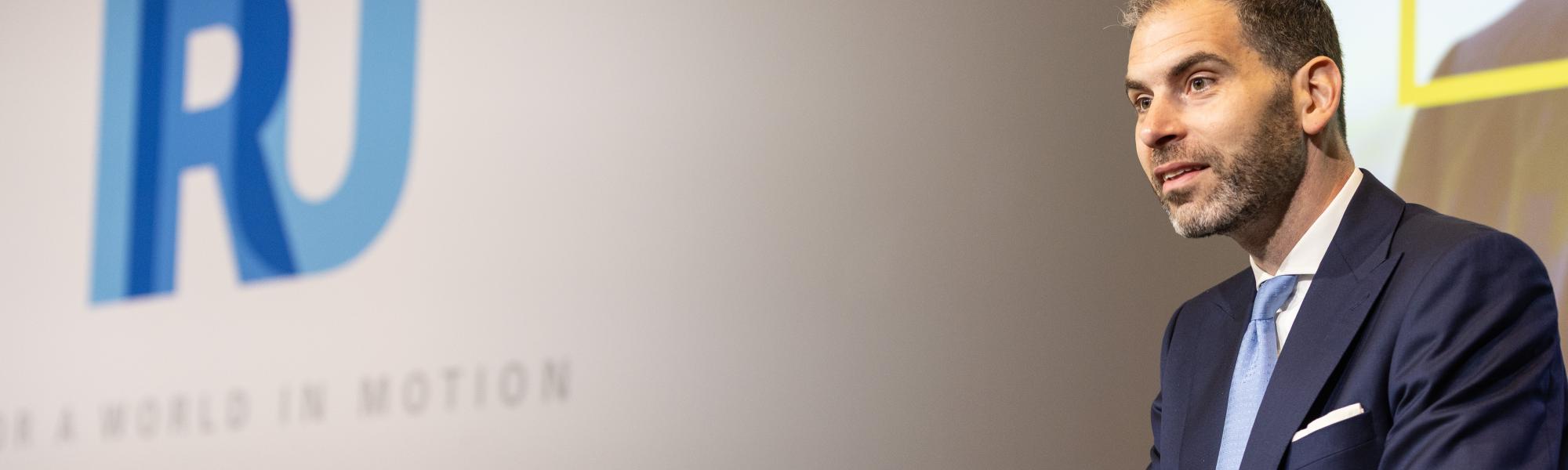
Habib Turki was officially confirmed as the organisation’s new Secretary General today in Geneva. Proposed by the Presidential Executive, IRU’s governing board, and voted in by IRU members, he will succeed current Secretary General Umberto de Pretto.

Habib Turki

As IRU’s next Secretary General, Habib Turki will draw on nearly two decades of experience in trade, development and transport at international organisations to advance safe, efficient and green road transport.

Habib Turki previously served as IRU’s Regional Adviser for the Middle East from 2015 to 2018. During that time, he successfully positioned and grew IRU’s presence in the region, advocating for the accession of Oman, Palestine, Qatar and Saudi Arabia to the TIR system. He also oversaw the implementation of TIR in the United Arab Emirates.

In 2019, he joined the Fédération Internationale de l’Automobile (FIA), where he developed the Tourism Services Department and led FIA’s advocacy at the United Nations and other international organisations.

In 2024, he was promoted to FIA’s Chief Development Officer to drive global growth through institutional partnerships, market development and international representation. He negotiated partnerships and agreements with international organisations and governments, while supporting FIA’s expansion in China and across Asia.

“It is an honour to be appointed IRU Secretary General. I am delighted to work again with IRU members across the globe,” said Habib Turki.

“IRU’s rich history speaks for itself: from reviving war-torn trade links in post-war Europe with the TIR system and advancing road safety globally to leading the pragmatic, sustainable decarbonisation of our industry. I am excited to lead the organisation into its next chapter.”

Habib Turki will officially take over as IRU Secretary General on 1 August 2026.

Source

caspian-routes-gain-popularity-transit-through-turkmenistan-increased-70

Caspian Routes Gain Popularity: Transit Through Turkmenistan Increased by 70%

caspian-routes-gain-popularity-transit-through-turkmenistan-increased-70

Against the backdrop of tensions in the Middle East, transport routes through the Caspian region are experiencing growing demand. Under these conditions, Turkmenistan is strengthening its role as one of the key transit links in international logistics corridors, trans.ru reports.

According to the publication, China has intensified the use of the eastern branch of the International North–South Transport Corridor for shipping goods to Iran. The route passes through Russia, Kazakhstan, Turkmenistan, and Iran. At the same time, part of the cargo destined for Europe has been redirected to the Trans-Caspian International Transport Route.

This is the second time in recent years that interest in Caspian transport corridors has significantly increased. Previously, their importance grew substantially in 2022, when countries needed alternative cargo delivery routes bypassing traditional pathways.

Particular attention is currently being paid to the eastern branch of the North–South Corridor passing through Turkmenistan. As ORIENT reported, in January–April 2026, the volume of container transportation through the country increased by 70% compared to the same period last year.

During the first four months of this year, 19 container trains on the “China–Iran” route and 25 trains operating along the “Russia–Iran–Russia” route passed through Turkmenistan’s railways.

The growing importance of Caspian routes is also linked to restrictions on shipping through the Strait of Hormuz and the Suez Canal. As a result, China and other countries are being forced to make greater use of overland transport corridors, including routes through Central Asia and the Caspian Sea.

According to the Argus agency, in the first quarter of 2026, the volume of transit freight trains from China passing through Kazakhstan and Azerbaijan more than doubled compared to the same period last year.

Source

«Помогите нам помочь вам»: МСАТ обращается к министрам транспорта на Саммите ITF

‘Help us help you’: IRU tells transport ministers at ITF Summit

«Помогите нам помочь вам»: МСАТ обращается к министрам транспорта на Саммите ITF

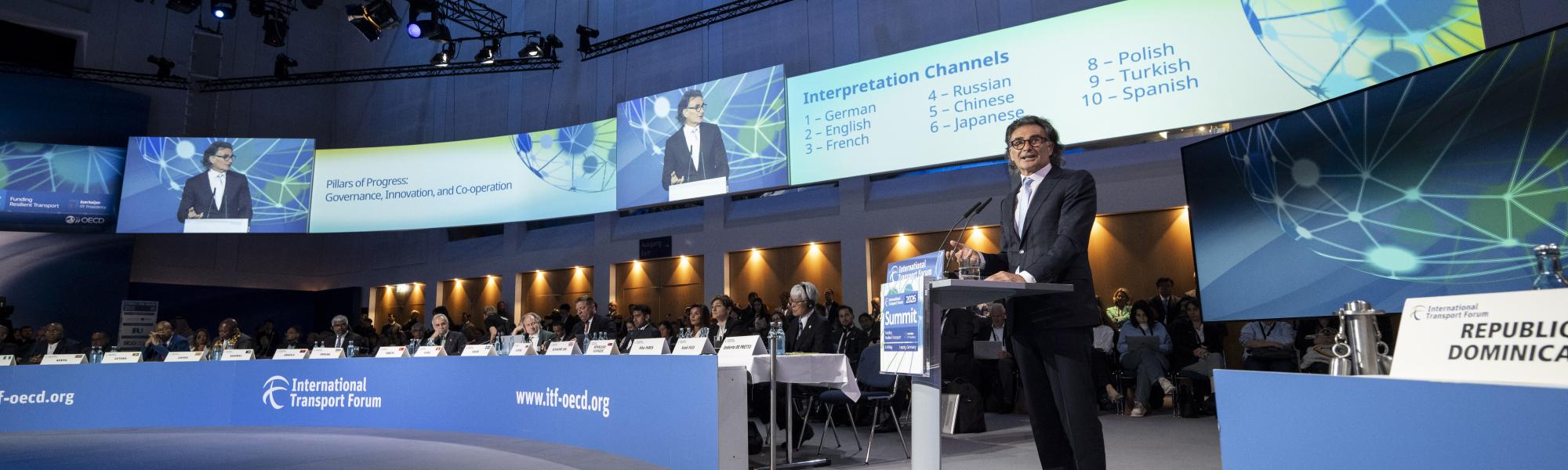
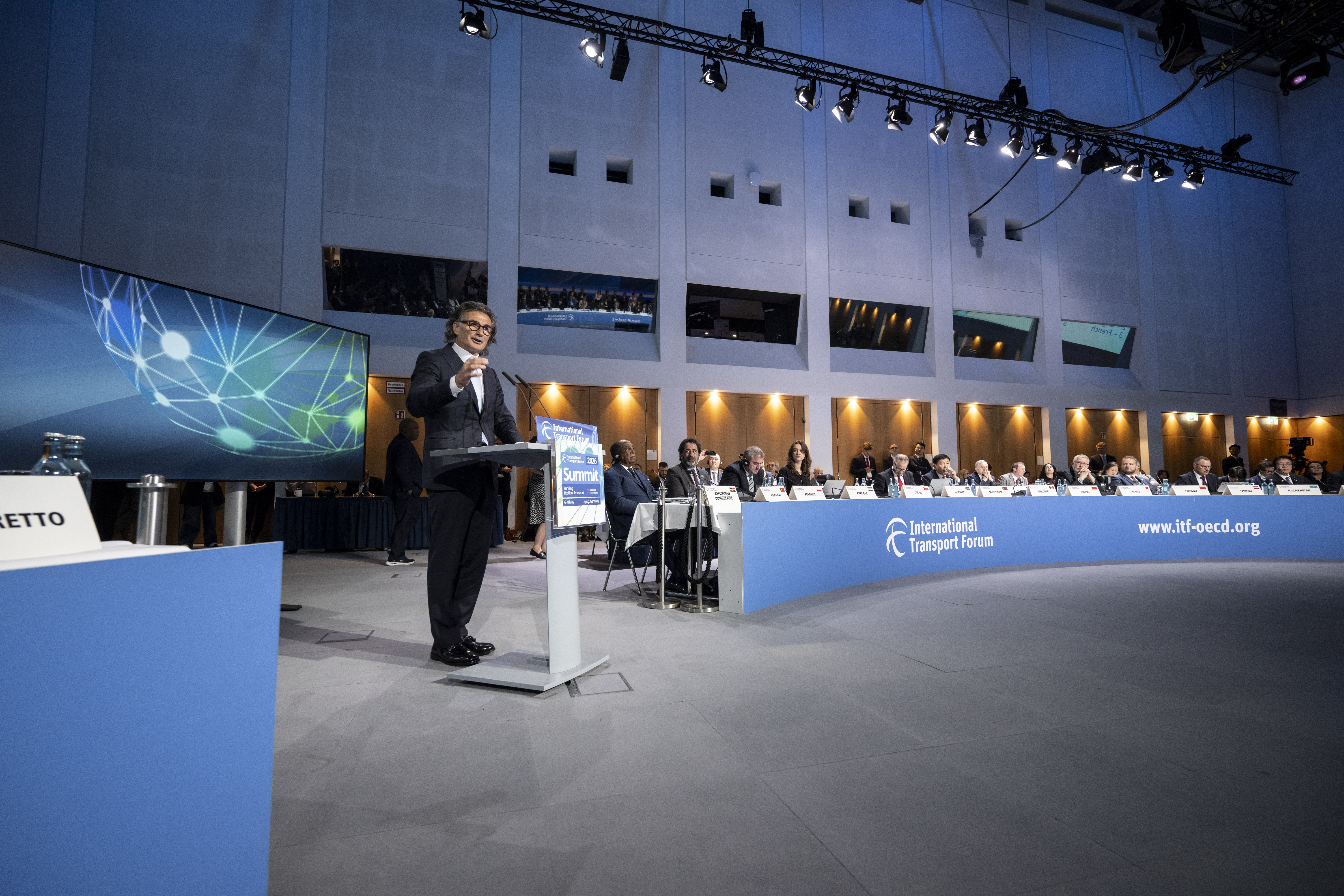
At the 2026 International Transport Forum (ITF) Summit in Leipzig, IRU’s Secretary General delivered a stark message to ministers and transport leaders: the world has entered a state of permanent crisis mode, and governments must move from discussion to action to help transport systems respond to growing global disruptions.

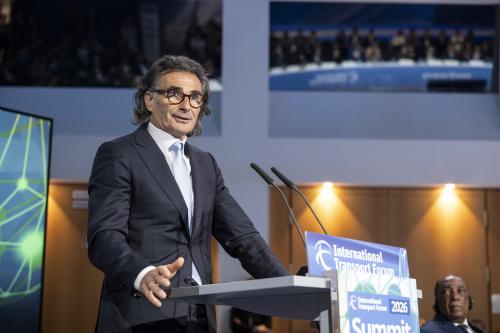
Speaking during today’s ministerial session “Pillars of Progress: Governance, Innovation, and Cooperation”, IRU Secretary General Umberto de Pretto warned that wars, natural disasters and geopolitical instability are placing unprecedented pressure on global mobility and logistics networks.

“Every year, we talk about crises. Wars in the Middle East, Europe, Africa and elsewhere disrupt transport operations. Natural disasters damage infrastructure. Covid showed how vulnerable transport can be. We seem to be in permanent crisis mode these days.”

But road transport, he stressed, is not only a victim of instability. “Transport is also crucial to how the world deals with crises.”

Representing an industry of more than 3.5 million road transport companies worldwide, Umberto de Pretto highlighted the essential role of buses, coaches, taxis, vans and trucks in maintaining resilient supply chains and mobility services. “We are the glue that makes intermodal networks work. We are the first and last mile.”

Drawing on the current war in Iran and conflict in the Middle East, he described how road transport operators are helping populations affected by war while simultaneously adapting supply chains under extreme pressure.

umberto de pretto

“We are not only hugely impacted by the current crisis in fuel price and supply, our work is also crucial in helping those affected by this war – from moving people fleeing conflict to redeploying truck routes across the wider Middle East and rerouting shipments carrying essentials.”

His central message to governments was direct: “Let us do our job. Help us be more resilient; don’t hinder our resilience.”

Umberto de Pretto pointed to three priorities requiring urgent action: borders, bureaucracy and digitalisation.

On borders, he called for wider use of the TIR system to enable faster and more secure cross-border transport during crises. “TIR strengthens resilience by enabling flexibility in transit routes. When traditional corridors are disrupted, the system absorbs the shock and trade keeps moving.”

He cited the rapid rerouting of cargo through Iraq as an example of resilience in action. “TIR trucks are crossing Iraq rapidly and securely, enabling swift rerouting of cargo from the GCC to Türkiye and on to Europe.” He noted how Iraq has reduced some journeys from Poland to Dubai from 24 days to just 10.

Turning to bureaucracy, Umberto de Pretto criticised outdated visa and administrative processes that continue to slow down transport operations during emergencies. “Driver visas and processes are stuck in the last century. Remove visas, at least in times of crisis, or, at the very least, make the processes fast and efficient.”

He also urged governments to accelerate digitalisation efforts. “Digitalisation is a real buzzword. It’s great to talk about AI and new technology, but we are still decades behind on some of the most basic digitalisation opportunities that would bring real benefit to operators.”

Umberto de Pretto also expressed frustration at the lack of implementation following repeated political commitments on resilience. “After Covid we talked about ‘building back better’. Are we succeeding? Well, not really.”

“Let us stop talking and start acting,” he urged ministers. “Help us help you.”

Help us help you

Source

Turkmenistan participates in the International Transport Forum summit in Leipzig

Turkmenistan participates in the International Transport Forum summit in Leipzig

Turkmenistan participates in the International Transport Forum summit in Leipzig

A delegation from Turkmenistan is participating in the Annual Summit of the International Transport Forum (ITF) in Leipzig, Germany. This was reported by the press service of the Turkmen Ministry of Foreign Affairs.

The forum, chaired by Azerbaijan, is the second part of the three-year ITF summit program for 2025–2027, dedicated to transport sustainability. The event brings together transport ministers from 69 ITF member states, heads of leading industry companies, and representatives of academia and international organizations.

The Turkmen delegation is led by Suleiman Durdyev, Deputy Chairman of the State Service “Turkmenhowayollary.” It includes representatives from the Cabinet of Ministers, the Ministry of Foreign Affairs, and the Ministry of Railway Transport of Turkmenistan.

During the forum, participants will discuss investment mechanisms and financing strategies aimed at increasing the resilience of transport systems in the face of climate change, extreme weather events, pandemics, cyberattacks, and geopolitical instability.

Turkmenistan consistently promotes the principles of transport diplomacy, advocating for the digitalization of the industry and the introduction of environmentally friendly modes of transport. The country is strengthening its position as a major transit hub in Eurasia, promoting economic stability and international cooperation in the region, the report notes.

Source